
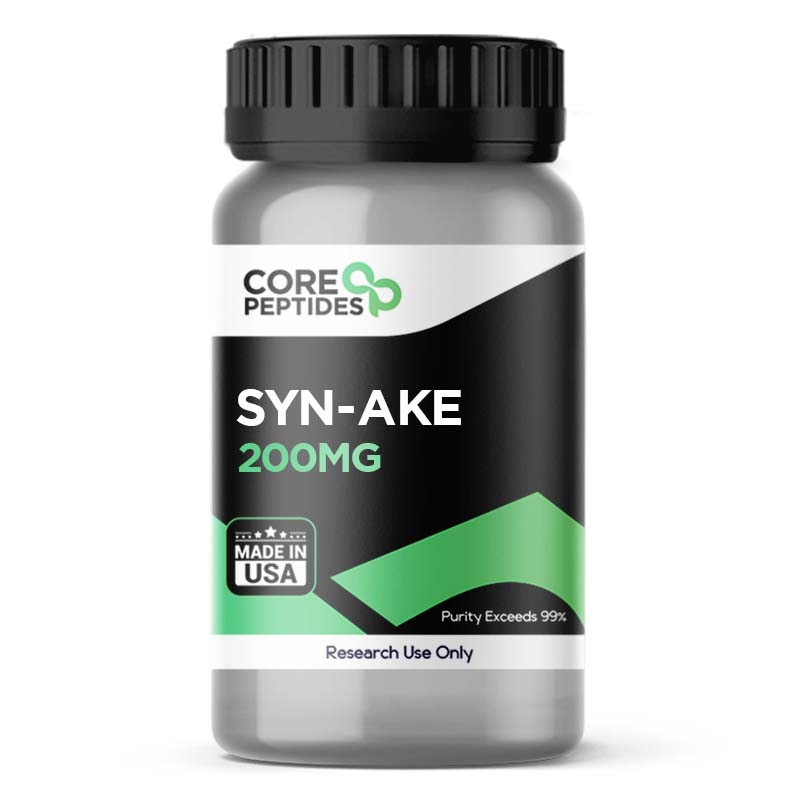
Syn-AKE (200mg)
$176.00
Size: 200mg
Contents: Syn-AKE
Form: Lyophilized powder
Purity: >99%
SKU: P-SYN-AKE
FREE Shipping on $200+ orders
Description
Syn-AKE (200mg)
Product Overview
Syn-AKE is a synthetic tripeptide compound researched for its potential interaction with neuromuscular signaling pathways and peptide-based cosmetic science applications. This 200mg formulation is designed for laboratory research involving peptide mechanisms, receptor interactions, and skin biology studies.
Syn-AKE has been studied because of its structural similarity to a specific region of Waglerin-1, a naturally occurring peptide investigated for its interaction with muscle contraction pathways. Research suggests that Syn-AKEmay influence signaling associated with acetylcholine receptors, making it a subject of interest in studies focused on facial muscle activity and expression-related skin research.
This product is intended exclusively for qualified laboratory and research applications and is not formulated for human consumption or medical use.
What Is Syn-AKE (200mg)?
Syn-AKE is a synthetic peptide also known as Tripeptide-3 or Syn-AKE acetate. It is composed of amino acids designed to replicate certain characteristics of Waglerin-1, a peptide originally studied for its interaction with neuromuscular communication.
The peptide sequence of Syn-AKE includes alanine, proline, and diamino butyrate components linked through peptide bonds. Researchers have investigated its potential ability to interact with nicotinic acetylcholine receptors (nAChRs), which are involved in communication between nerves and muscles.
Because muscle contraction plays a role in facial expression movement, Syn-AKE has become an area of interest in cosmetic peptide research related to the appearance of fine lines and wrinkles.
Key Characteristics
- Contains 200mg of Syn-AKE peptide
- Also known as Tripeptide-3
- Synthetic peptide designed for research applications
- Studied for receptor interaction and peptide signaling
- Investigated in cosmetic science and skin biology research
- Manufactured for laboratory evaluation
Chemical Information
- Compound Name: Syn-AKE
- Alternative Name: Tripeptide-3, Syn-AKE acetate
- Molecular Formula: C23H37N5O7
- Molecular Weight: Approximately 495.57 g/mol
How It Works (Research Context Only)
Syn-AKE Peptide Mechanism of Action
Research into the Syn-AKE Peptide Mechanism of Action focuses on its possible interaction with neuromuscular signaling pathways.
Syn-AKE was designed based on the activity of Waglerin-1, a peptide studied for its ability to interact with nicotinic acetylcholine receptors. These receptors are involved in transmitting signals that contribute to muscle contraction.
Laboratory research suggests that Syn-AKE may interact with specific receptor sites associated with muscle signaling. This interaction has been investigated for its potential to temporarily influence muscle contraction activity in experimental models.
Unlike naturally occurring Waglerin-1, Syn-AKE was developed as a smaller synthetic peptide designed specifically for research into peptide-receptor interactions.
Research findings remain dependent on experimental conditions, and further studies are needed to fully understand the biological effects and mechanisms involved.
Research Applications (Neutral)
Syn-AKE Peptide and Fine Lines, Wrinkles
One major area of interest for Syn-AKE Peptide and Fine Lines, Wrinkles research is the relationship between facial muscle movement and visible skin characteristics.
Repeated facial expressions involve muscle contractions beneath the skin surface. Researchers have investigated whether peptides such as Syn-AKE may influence contraction-related pathways and whether this interaction could affect the appearance of expression-related lines in research models.
Some cosmetic research studies have examined topical peptide formulations containing Syn-AKE and evaluated changes in wrinkle appearance and skin surface characteristics.
These findings represent research observations and should not be interpreted as guaranteed cosmetic outcomes.
Syn-AKE and Skin Biology Research
Peptide compounds are widely studied in cosmetic science due to their potential ability to interact with cellular communication pathways.
Syn-AKE research focuses primarily on receptor interactions, peptide stability, and biological signaling rather than direct therapeutic applications.
Researchers continue exploring how synthetic peptides may contribute to understanding skin structure, facial muscle activity, and cosmetic formulation science.
Syn-AKE Compared With Other Peptides
Syn-AKE belongs to a broader category of cosmetic peptides, each designed to investigate different biological pathways.
For example:
- Some peptides are studied for collagen-related pathways.
- Some peptides are researched for hydration and barrier support.
- Syn-AKE is primarily investigated for its potential relationship with muscle signaling pathways.
Understanding these differences helps researchers evaluate peptide functions based on their specific mechanisms.
What Is Palmitoyl Tripeptide-5 Used For?
What is palmitoyl tripeptide-5 used for? Palmitoyl Tripeptide-5 is a different peptide compound from Syn-AKE. It is commonly researched for collagen-related pathways and extracellular matrix studies.
Although both are tripeptides used in cosmetic research, Syn-AKE and Palmitoyl Tripeptide-5 have different structures and research mechanisms.
What Is Syn-Coll Peptide?
What is Syn-Coll peptide? Syn-Coll is another synthetic peptide used in cosmetic research, also known as Palmitoyl Tripeptide-5.
Syn-Coll is primarily studied for collagen synthesis pathways, while Syn-AKE research focuses on neuromuscular signaling and receptor interaction.
Both compounds demonstrate how different peptide structures can be designed for different research purposes.
Is Tripeptide a Retinol?
Is tripeptide a retinol? No. Tripeptides and retinol are separate types of compounds.
Retinol is a vitamin A derivative studied for its effects on skin cell processes, while tripeptides are short chains of amino acids researched for their signaling properties.
Although both may appear in cosmetic science discussions, they function through different mechanisms.
Trust & Quality Signals
- Produced for scientific research purposes
- Suitable for peptide and cosmetic formulation studies
- Quality-controlled manufacturing standards
- Intended for laboratory evaluation
- Not approved for human consumption or medical applications
Frequently Asked Questions
What is Syn-AKE peptide?
Syn-AKE is a synthetic tripeptide-3 compound studied for its potential interaction with neuromuscular signaling pathways.
What is Syn-AKE used for?
Syn-AKE is researched primarily in peptide science and cosmetic research involving muscle signaling and skin-related studies.
How does Syn-AKE work?
Research suggests Syn-AKE may interact with pathways involving nicotinic acetylcholine receptors, which are associated with muscle contraction signaling.
Is Syn-AKE the same as Syn-Coll?
No. Syn-AKE and Syn-Coll are different peptides with different research focuses.
Is Syn-AKE a retinol alternative?
No. Syn-AKE is a peptide compound, while retinol is a vitamin A derivative.
Can Syn-AKE be used on humans?
This product is supplied strictly for research and laboratory use and is not intended for human application.
Conclusion
Syn-AKE is a synthetic tripeptide compound studied for its potential interaction with neuromuscular signaling pathways and peptide-based cosmetic research applications. Research suggests that Syn-AKE may influence receptor-related processes associated with muscle contraction pathways, making it a subject of interest in studies involving fine lines and wrinkle-related research.
As with all research peptides, current findings are dependent on specific laboratory models and further investigation is required to understand their broader biological significance. Syn-AKE (200mg) is intended exclusively for qualified laboratory research applications.
Disclaimer
For research/laboratory use only.
This product is intended solely for scientific research purposes. It is not intended for human consumption, topical use, diagnosis, treatment, prevention, or cure of any disease or medical condition. Researchers should follow all applicable regulations, safety procedures, and institutional guidelines when handling research compounds.
References:
- Balaev, A. N., Okhmanovich, K. A., & Osipov, V. N. (2014). A shortened, protecting group free, synthesis of the anti-wrinkle venom analogue Syn-Ake exploiting an optimized Hofmann-type rearrangement. Tetrahedron Letters, 55(42), 5745-5747.
- Molles, B. E., Tsigelny, I., Nguyen, P. D., Gao, S. X., Sine, S. M., & Taylor, P. (2002). Residues in the epsilon subunit of the nicotinic acetylcholine receptor interact to confer selectivity of waglerin-1 for the alpha-epsilon subunit interface site. Biochemistry, 41(25), 7895–7906. https://doi.org/10.1021/bi025732d
- Gorouhi, F., & Maibach, H. I. (2009). Role of peptides in preventing or treating aged skin. International journal of cosmetic science, 31(5), 327–345. https://doi.org/10.1111/j.1468-2494.2009.00490.x
- Reddy, B., Jow, T., & Hantash, B. M. (2012). Bioactive oligopeptides in dermatology: Part I. Experimental dermatology, 21(8), 563–568. https://doi.org/10.1111/j.1600-0625.2012.01528.x
- Munawar, A., Ali, S. A., Akrem, A., & Betzel, C. (2018). Snake venom peptides: Tools of biodiscovery. Toxins, 10(11), 474.
- TATARINGA, G., & ZBANCIOC, A. M. (2021). Antirid peptides in a cosmeceutical formula. Romanian Journal of PHARMACEUTICAL PRACTICE| Vol. XIV, 58(3).
- Chhipa, N. M., & Chaudhari, B. (2012). Toxin as a Medicine. Journal of Current Pharmaceutical Research, 9(1), 11-8.
- Trookman, N. S., Rizer, R. L., Ford, R., Ho, E., & Gotz, V. (2009). Immediate and Long-term Clinical Benefits of a Treatment for Facial Lines and Wrinkles. The Journal of clinical and aesthetic dermatology, 2(3), 38–43.
- Reddy, B. Y., Jow, T., & Hantash, B. M. (2012). Bioactive oligopeptides in dermatology: Part II. Experimental dermatology, 21(8), 569–575. https://doi.org/10.1111/j.1600-0625.2012.01527.x
- Pai, V. V., Bhandari, P., & Shukla, P. (2017). Peptides as cosmeceuticals. Indian Journal of Dermatology, Venereology and Leprology, 83, 9.
Reviews
There are no reviews yet.